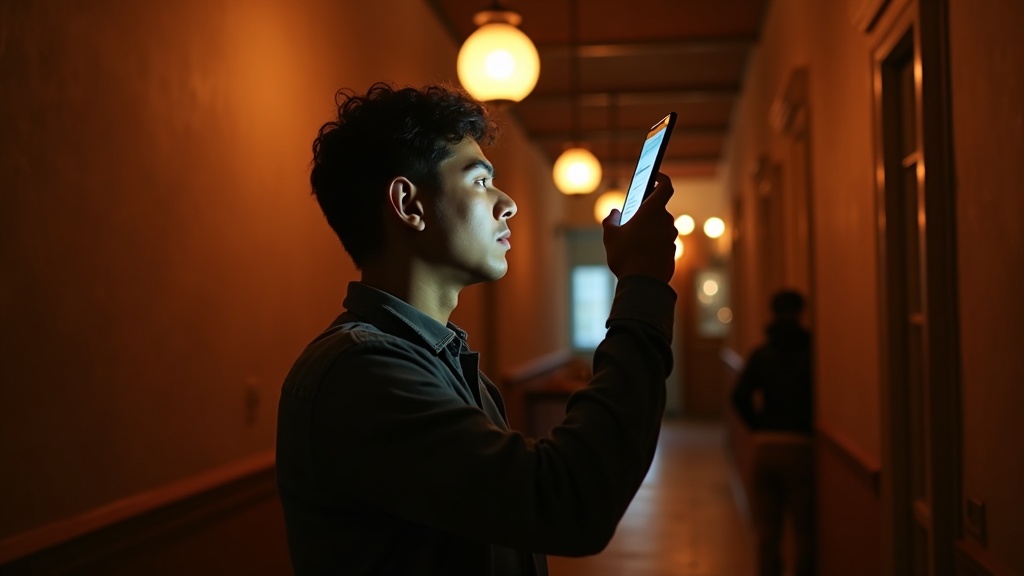
You point your phone at something in a dimly lit room, tap to focus, and the photo comes back blurry, grainy, or weirdly dark — even though your eyes had no trouble seeing it. You try again. Same result. It feels like a software bug, or something a future update should fix.
It’s not. The real reason your phone struggles in low light is physical. The sensor is tiny, the lens can only open so wide, and darkness is genuinely hard to capture when your entire camera system is thinner than a pencil. Computational tricks help, but they’re working around a ceiling set by physics — not pushing past it.
This piece isn’t about how to take better photos at night. It’s about why the problem exists in the first place, and why some of it will never fully go away.
What a camera actually needs to make a picture
A camera has one basic job: collect light and turn it into an image. That’s it. Every part of the process — the lens, the sensor, the software — exists to serve that single task.
Think of it like filling a bucket in the rain. The more it rains, the faster the bucket fills and the more you end up with. Bright sunlight is a downpour. A dim restaurant is a light drizzle. Your camera is always trying to fill that bucket, no matter the conditions.
When there’s plenty of light, the camera has a lot to work with. The image it produces is rich with real information. But when light is scarce, the camera is essentially guessing at parts of the picture it simply couldn’t collect enough of.
Those guesses are where things go wrong. Blur, grain, washed-out colors — these aren’t random glitches. They’re what happens when a camera doesn’t have enough light to be certain about what it’s seeing. Darkness doesn’t just make photos darker. It makes them harder to get right.
The size problem phones cannot escape
Think of a camera sensor as a bucket catching rain. The bigger the bucket, the more rain it collects. That’s exactly how light works with a camera — a larger sensor catches more of it, and in low light, that difference is everything.
A camera from a dedicated system — the kind with interchangeable lenses — has a sensor that dwarfs what’s inside your phone. Not slightly bigger. Many times bigger. That’s not a design flaw in your phone. It’s a physical trade-off built into the moment you decided you wanted a device that fits in your pocket.
Your phone is maybe 7 or 8 millimetres thin. The sensor has to live inside that space, alongside a battery, a screen, a processor, and everything else. There’s simply no room for anything larger. Physics doesn’t negotiate.
This is the root of the problem. When light is scarce, a tiny sensor can only gather a tiny amount of it — no matter how clever the software running on top. Software can do a lot. But it cannot invent light that the sensor never captured in the first place.
How the lens opening limits what gets in
Light doesn’t just fall onto the sensor by magic. First, it has to pass through an opening in the lens. The wider that opening, the more light floods in. Think of it like a window — a bigger window lets more light into a room, even if the sun is equally bright outside.
Professional cameras can use lenses with very wide openings. Photographers can even swap lenses depending on how dark the environment is. If the light is low, they grab a lens built to let in as much as possible.
Your phone has no such option. The lens is small, fixed, and built directly into the body. It cannot open any wider than it already does. You cannot replace it with something better suited for a dark restaurant or a dimly lit street.
So the lens creates its own ceiling, completely separate from the sensor. Even if the sensor were somehow perfect, there is only so much light getting through that small fixed opening in the first place. The phone is already working with less raw material before any processing even begins.
Why boosting sensitivity creates its own problem
When a scene is dark, your phone’s camera tries to make the most of the limited light it receives. One way it does this is by amplifying the signal coming off the sensor — essentially turning up the volume on whatever light did arrive. This is roughly what happens when your phone pushes to a higher sensitivity setting.
The problem is that amplification doesn’t care what it’s boosting. Along with the real signal — the actual light from your subject — there’s always a small amount of random electrical interference in the sensor. Normally that interference is too small to notice. But turn up the amplification, and it gets louder too.
What you see in the photo is grain. Sometimes colored speckles. A kind of visual static that wasn’t in the scene itself, just in the electronics reading it.
On a large camera sensor, this matters less. There’s enough raw signal to begin with that the interference stays relatively quiet even after amplification. On a phone sensor, the signal starts out much weaker — so when you amplify it, the noise gets a proportionally bigger boost. You’re not just brightening the image. You’re also brightening everything wrong with it.
Sensitivity, in other words, isn’t free. The phone is making a trade: a brighter image, but a messier one.
Why longer exposures do not simply fix the problem
If the sensor isn’t catching enough light, the obvious answer sounds simple: just keep the shutter open longer. Wait for more light to arrive. Problem solved, right?
Not really. The moment you extend the exposure, time becomes the enemy. A longer exposure captures everything that moves — including the phone itself. Your hands are never perfectly still. Even a tiny tremor over a fraction of a second is enough to smear the image into a blur.
Then there’s whatever you’re actually photographing. A person talking, a child fidgeting, a candle flame flickering — none of these stay frozen while your phone waits for enough light. The world doesn’t pause just because the camera needs more time.
A photographer with a big camera can screw it onto a tripod, set everything up carefully, and wait. That’s a controlled situation. A phone is a handheld device pulled out of a pocket in a restaurant, at a birthday party, at a concert. The conditions are messy and unpredictable by nature.
So gathering more light by simply waiting longer runs into a hard physical limit: real life keeps moving, and the camera can’t stop it.
What computational photography is actually doing
When you tap the shutter in night mode, your phone doesn’t just take one photo. It takes a quick burst of them — sometimes ten, sometimes more — and merges them into a single image. The idea is straightforward: each shot captures a slightly different pattern of random noise, but the actual light in the scene stays consistent. Stack enough frames together and the noise starts to cancel out, while the real signal adds up.
Think of it like listening to someone talk in a noisy room. You might miss a word once, but if they repeat themselves several times, you start to piece together what they said. Your phone is doing something similar — using repetition to separate signal from randomness.
The results can be genuinely impressive. A night mode photo often looks far brighter and cleaner than a single shot would. But here’s the thing: the phone is working with the same small amount of light the lens physically collected. It’s getting smarter about using that light — not conjuring more of it.
Software can reduce noise, but it can’t recover detail that the sensor never captured in the first place. If the light just wasn’t there, no amount of processing can put it back. That’s the ceiling computational photography runs into, and it’s set by physics, not by the software.
What software still cannot overcome
Software can do a lot, but it cannot invent light that was never there. When a scene is genuinely dark, the sensor picks up so little real signal that noise takes over completely. And when you stack noisy frames together — which is exactly what night mode does — you still end up with a noisy result. Averaging garbage does not produce clarity.
The same limit applies to moving subjects. To freeze motion, the shutter has to be fast. But a fast shutter means less time for light to reach the sensor. The phone is caught between two bad outcomes: blur or darkness. No algorithm resolves that trade-off, because the trade-off is physical.
Color and fine detail suffer for the same reason. Below a certain light level, the sensor simply does not collect enough information to reconstruct what was really there. Software can guess, and it often guesses plausibly — but guessing is not the same as capturing.
This is why the gap between a phone and a larger camera does not shrink in real darkness the way it does in decent light. A bigger sensor gathers more actual signal to begin with. That head start compounds. No amount of processing closes a gap that opens at the point of capture.