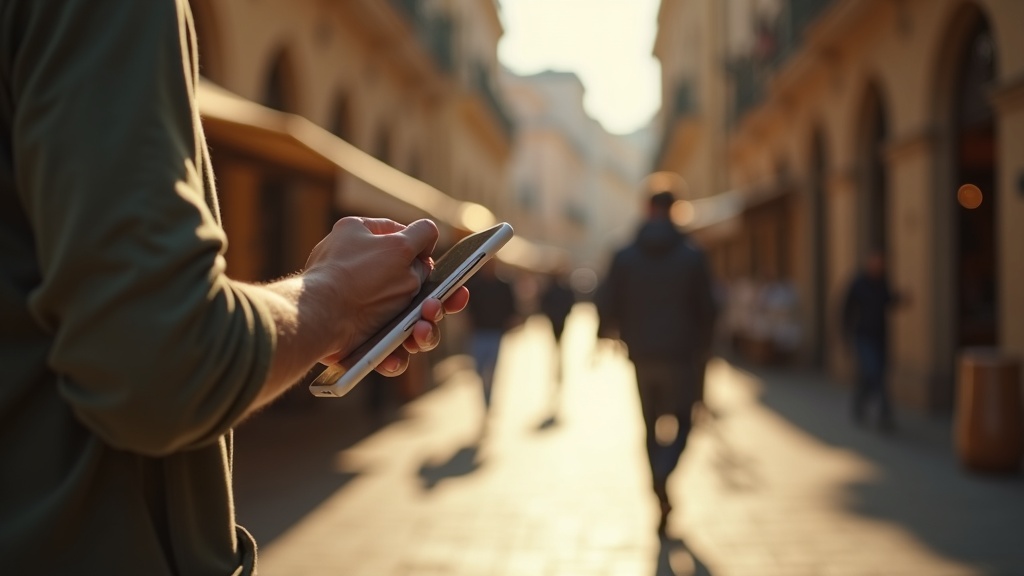
You spot a great moment — someone laughing, a shadow cutting across the pavement, two strangers almost touching without knowing it. You raise your phone. And then the awkwardness kicks in. Do they see you? Are you being weird? You hesitate, and the moment’s gone.
Shooting street photography on a smartphone comes with a specific problem most people don’t name directly: the wide lens forces you to get close. There’s no zooming in from a safe distance. To fill the frame, you have to actually be there — near enough to feel like you’re intruding.
That closeness is uncomfortable at first. But it’s also what makes smartphone street photos feel alive in a way that long-lens shots rarely do. Once you know how to use it, the constraint becomes the whole point.
Why your phone pushes you closer than you expect
Most smartphones shoot with a wide lens. That sounds fine until you try to photograph a stranger on the street and realise they take up about a tenth of your screen. Step back a little more and they practically disappear into the background.
A wide lens captures a lot of scene all at once. It’s great for landscapes. It’s awkward for people. To make someone the clear, obvious subject of a photo, you have to be physically close to them — closer than most people instinctively feel comfortable with.
This is the exact opposite of how most of us imagine street photography works. We picture a photographer hanging back, zooming in from a distance, nobody noticing. That’s a camera with a telephoto lens. It compresses space and pulls a distant subject right into the frame. Your phone can’t do that by default.
So the smartphone creates a real tension: to get a compelling shot, you need to close the gap between you and the person you’re photographing. And closing that gap is precisely what feels awkward, obvious, and — if you’re not careful — a little intrusive. That’s the challenge this whole approach is built around solving.
The wide lens is a tool, not a problem
Most people treat the smartphone’s wide lens as a limitation. You can’t zoom in, you can’t isolate a face, you can’t blur out a messy background. So the thinking goes: the phone is just worse at this kind of photo.
But that framing gets it backwards. A wide lens doesn’t strip context away — it keeps it. And in street photography, context is the whole point.
Think about this: a woman eating from a street food stall. Shoot her tight and zoomed, and you get a face. Maybe a good face. But you lose the stall, the steam rising from the pan, the person behind her waiting, the overhead sign half in frame. You lose the street. Shoot her close with a wide lens and all of that stays in the picture. Her expression sits inside a living, specific place. The image feels like it actually happened somewhere.
That’s not a compromise. That’s a different kind of image — and often a more honest one.
The catch is that wide means close. To fill enough of the frame with your subject, you have to actually be near them. That’s where the discomfort comes from. But the solution isn’t to wish you had a zoom. It’s to get comfortable being close — and to use that proximity intentionally, knowing what you’re going to get when you do.
How to position yourself so you blend in
The moment you react to a scene — spotting someone interesting, quickly raising your phone, pointing it at them — is the moment people notice you. The movement itself is the giveaway. So instead of chasing moments, try arriving at them early.
Pick a spot that already has something going for it: good light, an interesting background, a natural flow of foot traffic. Set your frame. Then just wait. People will walk into it. You don’t have to pursue anyone.
While you wait, holding your phone at chest height like you’re reading a message is completely unremarkable. So is glancing down at it occasionally. What draws attention is the raised arm, the obvious framing, the repeated pointing. Stillness, on the other hand, barely registers. Standing still in a city just looks like someone waiting for a friend.
When you do shoot, try a slight angle rather than facing someone head-on. Turning maybe thirty degrees to the side makes the gesture feel less directed — and it often makes the photo better too, since you get a little depth and movement into the frame instead of a flat, confrontational composition.
None of this is about hiding what you’re doing. It’s more like how a good conversationalist listens before they speak. You’re reading the street, settling into it, and letting the picture come to you rather than grabbing for it.
Shooting from the hip without losing the shot
Raising your phone to eye level is the moment people notice you. Your arm goes up, your face disappears behind the screen, and suddenly you’re obviously taking a photo. Hip-level shooting sidesteps all of that. You hold the phone at waist height, angled very slightly upward, and press the shutter without ever looking at the screen.
Yes, you’ll miss a lot of shots. That’s just the reality of it. But the ones you get are different in a way that’s hard to fake — genuine expressions, unguarded posture, moments that vanish the second someone sees a camera coming.
Use your volume button as the shutter. Your thumb barely moves, and nobody reads that gesture as photography. Turn off shutter sounds too, obviously. Tap the shutter rapidly or use burst mode so you’re grabbing several frames in one pass rather than gambling on a single one.
The angle itself works in your favour. A slightly low viewpoint makes people feel solid and present in the frame — not spied on from above, but real and close. It suits the smartphone’s wide lens well, because you’re already near your subject and that proximity fills the frame naturally.
The aiming problem is real, but it’s trainable. At home, practise holding the phone at your side and pointing it at objects across the room. Check the results. You’ll quickly build a feel for where the lens is actually pointing versus where you assume it is. After a few sessions, you’ll be surprisingly consistent on the street.
Reading the scene before you raise the phone
Most people treat street photography like hunting — constantly moving, always reacting, phone up the second something looks interesting. It feels productive. It mostly produces blurry, half-composed shots of the back of someone’s head.
Experienced street photographers do something that looks almost lazy from the outside. They stop. They find a spot with good light or an interesting background, and they just watch for a few minutes. They’re not waiting for inspiration. They’re reading what’s actually happening — where people tend to walk, how the light falls at that angle, whether someone pauses near that doorway or keeps moving.
Once you see the pattern, you pick your frame first. Maybe it’s a patch of warm afternoon light hitting the pavement, or a bold graphic painted on a wall. Then you wait for a person to walk into it. The shot becomes something you set up, not something you scramble after.
This matters even more with a smartphone. Your wide lens means you need to be close to your subject — closer than feels comfortable if you’re nervous and visibly hovering. But if you’re already standing somewhere with a reason to be there, just looking around, nobody thinks twice about you. Watching the scene first also tells you exactly how close you can get before people start noticing. Some spots, you can be two meters away. Others, five is already pushing it. You find that out by watching, not by guessing wrong mid-shot.
The anxious, chasing style doesn’t just produce worse photos. It makes you stand out. Someone constantly raising and lowering their phone, turning in circles, rushing toward things — that’s who people notice.
What to do when someone notices you
Most people are absorbed in their own world. They are not scanning the street for someone photographing them. The vast majority of shots you take, nobody will even register.
But sometimes someone does notice. Maybe they glance toward your phone. Maybe they make eye contact just as you shoot. The instinct is to immediately lower your phone and walk away. That is actually the worst thing to do — it looks exactly like you were doing something you shouldn’t. A natural pause, a slight shift of direction, continuing to move at the same pace — that reads as normal. Freezing or flinching does not.
If someone walks over and asks what you are doing, a short honest answer is all you need. Something like ‘I just like photographing the street’ lands fine almost every time. You do not need to justify yourself at length. Calm and brief is the whole strategy.
Holding your phone low — near your hip, or just casually in front of you — helps too. You already look like every other person on the street scrolling or texting. That is the point. The goal is not to be invisible. It is just to look unremarkable.
The anxiety around this moment is almost always bigger than the moment itself. Most interactions, when they happen at all, end in thirty seconds.
How to compose with layers so closeness looks intentional
The wide lens on your phone captures a lot of the world at once. That sounds like a problem when you’re close to someone, but it’s actually the point. Instead of fighting it, you can use everything in the frame — what’s right in front of you, your subject, and what’s behind them — to build a picture that feels rich rather than cramped.
Think of it as three layers. Something close, something in the middle, something further back. Each layer gives the eye somewhere to travel. The image stops feeling like you just pointed your phone at a stranger, and starts feeling like you captured a whole moment.
Here’s a real situation. You’re standing near a market stall. A person is browsing a few steps away. Behind them, there’s a wall stacked with bright fabric or painted signs. If you angle yourself so the edge of the nearest stall just clips the bottom corner of your frame, you now have three things working together — the stall, the person, the colour behind them. The closeness creates presence, not intrusion.
The foreground element doesn’t need to be sharp or even obvious. A blurred shoulder, a railing, the back of someone’s head — anything that sits between you and your subject adds a sense of depth. It tells the eye: there’s space here.
Once you start looking for this structure, you find it everywhere. You stop seeing a busy street as chaotic and start seeing it as a set of possible layers waiting to line up. That shift in how you look is what changes the photos.
When and where the light works in your favour
Midday sun is the enemy. It flattens faces, kills depth, and makes everyone squint. The light you want is low — early morning or late afternoon, when the sun is close to the horizon and wraps around things rather than hammering down on them. Shadows get longer, faces get shape, and ordinary streets start to look like somewhere worth pointing a camera.
But here’s the more useful thing to know: you don’t need to be out at golden hour to get good light. You just need to find where the contrast already exists. A narrow street where one side sits in deep shade and the other catches full sun. A covered market where light pours through gaps in the roof. A doorway that frames a bright pavement beyond it. These spots concentrate light naturally, and they do the work for you.
The trick with a smartphone is that you have to get closer to people than you’d like. Good light solves part of that problem. When someone steps from shadow into a patch of sunlight, the contrast is so striking that the closeness stops feeling intrusive — it starts feeling intentional. The image looks considered, not stolen.
So instead of chasing subjects, find a spot where the light is already doing something interesting and wait. Pre-frame the scene. When someone walks into it, you’re not scrambling to compose — you’re just pressing the button.